|
One part of
the Constitution that confuses people today
(And George Washington's duel)
When I read the laws I often find
that people do not understand the reason why things were placed in the Constitution.
Then in an effort to remain true to the Constitution they end up just being
confused. The reason for the two year limit on funds for the military is one
of these.
Prompted by the fear of standing
armies to which Story alluded, the framers inserted the limitation that ''no
appropriation of money to that use shall be for a longer term than two years.''
In 1904, the question arose whether this provision would be violated if the
Government contracted to pay a royalty for use of a patent in constructing guns
and other equipment where the payments are likely to continue for more than
two years. Solicitor-General Hoyt ruled that such a contract would be lawful;
that the appropriations limited by the Constitution ''are those only which are
to raise and support armies in the strict sense of the word 'support,' and that
the inhibition of that clause does not extend to appropriations for the various
means which an army may use in military operations, or which are deemed necessary
for the common defense. Relying on this earlier opinion, Attorney General Clark
ruled in 1948 that there was ''no legal objection to a request to the Congress
to appropriate funds to the Air Force for the procurement of aircraft and aeronautical
equipment to remain available until expended.''FindLaw
There must be hundreds of these misunderstandings
which I can clear up quickly from my memory of being Thomas Jefferson.
The two year limit is mainly because
of an adaptive process of humans that takes two years to complete. It probably
stems from early man's adaptation process to a new land that he has camped out
on. Most of the time when winter came or the next year the rain didn't fall
or the game became scarce or another tribe claimed it was their season to be
on the land (like North American natives often did) he had to be willing to
decamp without feeling a great loss and move on before it resulted in death
through starvation or warfare.
So for about two years he was a bit
confused and still willing to let go of the territory including the resources
and leave. However, when he stayed for two years in a row it was usually proof
that it was good land to live on and make a permanent home. Without realizing
it, his attitude automatically changed 180 degrees. That land was suddenly his
and he would fight to the death to defend it. The same thing with the resources
on the land. It was as much the resources that were important as the land itself.
That mean't the game, the fish, the weapons material (flint, trees, rocks and
hills) and the friendly neighboring tribes that were allies. This territoriality varies tremendously
among people with those in the military having it the most. It's not genetic
or else it's more often passed and expressed through the female genes as daughters seem
to exhibit it more than the sons. (At least that generals daughter I dated had
it fully 100% but I could be basing my assumption of insufficient evidence.)
We need our military men to have
this quality full and complete without us hindering it at all. We certainly
don't want to ever stifle them or that process. It's the protective side of
the process that saves our society from extinction. And we certainly want that
part to stay strong and intact in our military officers. It comes as a whole though and you can't trim
off any of it.
The army was provided with a set
amount of money (I think yearly) and then they got to spend it on what ever
they wanted to (I think). Every year (or if they spent all the money and needed
some more) they showed us what they had spent the previous money on unless it
was a secret. They would keep the information about secrets separate and when
they were no longer valued they would forthwith bring us up to date and with
years of details if we wanted to know them.
Military personnel are always guarded
about what they say. There was a phrase that a military person could inadvertently
kill 1,000 people by not telling a secret. By this we meant that if something
is a secret and a person avoids the entire subject then others knows there exists
a secret and what it is about. So military personnel have to be very guarded almost all the
time.
Politician's on the other hand must shoot
from the hip and can't be too guarded or people will doubt them and their sincerity.
So politicians and military leaders are usually of the opposite make up. Due
to their openness it is often difficult for politicians to keep from accidentally
exposing secrets or parts of them. Just about as bad is when they end a conversation
before they expose the fact that they are actively refraining from telling a
secret. Other people can conclude the worst and think the politician is dishonest
because they are not very 'open' and 'revealing'. Just knowing a secret and
having to steer clear of it is also very stressful for politicians. As such us politicians
didn't want to know the secrets so l made that part of the military's job.
Changing jobs as I did involved big transitions for
me. I had different roles over the years so that is probably why I understand
most aspects of the problem.
The two year limit did not apply
to basic long term contracts of the Army, on supplies or arms but had to do
simply with the money we gave them to spend as they felt appropriate.
If we saw or were told about any
influence by another power we confronted the Army about it when they came with
their hats off and hands out for more money. We researched corruption and found
it's an adaptation process that takes about two years to complete.
There is another reason for the two
year limit on spending.
It was to keep foreign governments
from gaining any control of U.S. forces. Often when it occurred in Europe it
was a government spies that were working in coordination with the arms companies.
Not understanding the basic underlying
reason for this two year rule often contributed to spies getting a foothold
in the army or the government.
After two years in place even spies
who are suspect for the entire two years will find they are suddenly being defended
by those very same people who had suspected them.
At about 18 months friendships become
permanent. So we cut it at two years. Buying arms from Europe was the standard
practice and it took over a year usually but could be done in less than two.
During this time friendships and corruption could start. The two years kept
both at a minimum.
Now with air transportation and
modern communication two years is a little too long of time but we did not give
Congress the ability to change that to a shorter time period.
Other than this limit we felt the
Army and Navy were the ones that knew best what they needed for our survival
and theirs so we didn't interfere with their buying sprees in any way.
Almost every time they got their funds appropriated.
Our main concern was not what they
were buying but who they were buying it from and who they were forming relationships
and partnerships with.
Some ships took up to five years
to build from design to sailing it out of the harbor (though most took less
than two years). Since the nation was so frail was in debt some the builders
wanted all the money in advance so obviously the two years stipulation did not
apply. These expenses were never considered as part of this clause in the Constitution.
The same thing held with building
forts as they took years to build.* We in the government never even got asked
for the funds to start forts. We found out the Army was building one like most
people did. When someone told us when they sailed by and saw them building a
fort. The Army or Marines would just start building the fort with the funds
we gave them the last time and since they were expensive we knew they would
come looking for more funds pretty soon.
I recall there were several 'affairs
of greed which ended up in grief' due to influence by another government.**
I hope that help clears some things
up. If you have any more questions contact me and I'll try to answer them.
*When I was president we bought Louisiana
so we needed harbors between Charleston and New Orleans. A ship was being sent
to explore the coast to determine possible locations and I was asked for my
advice. Whatever I said involved looking for birds and their activities. It
concerned pelicans, hawks, cranes and even the fish jumping out of the water.
I told them to notice where the birds were in the daytime, where they perched for
the night and where they fed. They did not understand a bit of what I was trying to explain to them and I never
have figured out if it was my failure to communicate adequately or their failure to
listen. They probably thought I was nuts as that was/is often the assumption
of those who did not understand me. (It's going to take time to update this
as I remember the conversation more completely.)
They came back about eight months later
and said they had located four ideal places for a harbor but lots of birds stayed
there at night. Thinking I was an environmentalist and protecting the birds
they left them alone and looked elsewhere.
Hawks would only perch at locations
with the best 360 degree view for miles around. This is exactly
the same requirement that a fort needs. For the men to see what was inland required
from an hour to days of cutting through dense brush and cane grass which sliced
men like blades. The exploration team missed this concept completely.
Cranes stayed in shallow water at
night so they had to stay in locations where there was almost no tide change.
No tidal action at all was ideal for our ships. They stayed in groups
from 12 to 40 miles apart. They would fly the distance for the best location.
That was the best way to narrow it down fast. Otherwise you had to sit half
a day to first find out the tide and you had to compare it to tide in the ocean.
You had to do it over months of time. You might find a place with low tidal
action and build a port. Then on a full moon and especially on a spring tide
the ocean would spill over a sand bar and in a half an hour the tide would go
up four feet. You could lose ships that were tied down to wharfs or tear up the
wharf, or both. Cranes would stay in the same place night after night and year after year when they found a good location. The exploration team missed this too.
That being delta land the bays were
often filled with sediment three or four feet deep and your plumb would drop
right through the silt to harder mud so a harbor could get built before they
found out it was really too shallow.
In shallow water small fish escape
the big ones by swimming away faster. In water that was deep enough for our
ships the large fish would often attack the small fish from below. The small
fish would then leap out of the water to escape them. (The exception to this
was when there were no small fish around. However that was easy to determine
since there would be no pelicans in the area.) They also missed this.
For each location these men spent
an average of two days cutting through jungle while getting cut to shreds by
cane grass and then sweltering in a little boat plumbing the bottom just to
find out something was amiss and then they would have to go to another likely
location and survey it for two days. There were literally hundreds of locations that they needlessly investigated.
They could have found out exactly
the same thing except with a more accurate bottom reading in two hours while
relaxing on the ship, counting birds and putting little 'X's on maps where the
fish jumped out of the water.
My mind jumps from A to D (or M if I am lucky) where other peoples mind leap I have no idea. I just know it is different. In any case they wasted six months.
They brought me a huge number of eggs for my egg collection, except I didn't
have one. (During bouts at a tavern during the closing days of the Revolutionary
war Ben Franklin said the eggs themselves made it an effeminate hobby and the rest of us
toasted in agreement.) They had eggs from birds that never nest below 50 feet
so just the eggs alone took a lot of work. They probably just pulled the branches
with ropes and caught the eggs as they fell.
I wonder where "Thomas Jefferson's
Egg Collection" ended up? Maybe the Library of Congress or the Jefferson
Foundation has that information.
That is something I need to put
on my list of about 1,500 things I need to look into when I have the time.
**One boondoggle involved a lot of
Austrian or Prussian 'monster mortars' (and a lot more of the same kind of cannons)
that were made with bands of steel reinforcing a soft brass barrels. These were
exotic cannons just like some of the things the military buys today.
The monster mortars did not have
the bands tightened evenly and they had to be since when the mortars were fired
the brass would expand like a balloon almost and only be stopped from exploding
by the steel bands circling them. So when it was fired the forces were unevenly
distributed and only one band would take all energy. They needed to be fired
about 200 times with smaller charges to get everything stretched tight so the
force when fired was distributed evenly.
Before it had been broken in they
would often explode. The steel bands and the brass became hundreds of small
flying pieces of shrapnel that would kill 30 soldiers or even more. A regular
mortars was made out of iron and didn't need breaking in. They rarely blew up
and when they did it was into five large pieces at the most. It rarely happened
and when it did usually only one or two men got killed.
These cannons had a fearsome reputation because
they could be fired twice a minute with 48 pounds of grape shot. Just one of
these mowed down half an approaching force of 5,000 soldiers marching in formation
and caused them to desert before they ever got into musket range. However untrained
men couldn't seem to break them in right and anyway who had 200 charges of powder
to waste breaking them in.
 [Added
April 28, 2005. Oops, it was 49 Kilograms and not 48 pounds. I was looking for
pictures to spice up this page and found a similar mortar here.
Ours had two straps and not the one. Even though it says 49 and not 48 it's
reference was to solid cannon balls and not grape shot which has more air gaps.
It's a problem recalling a number and not the unit of weight. I hope I don't
mess and forget details and examples when I talk about the laws.] [Added
April 28, 2005. Oops, it was 49 Kilograms and not 48 pounds. I was looking for
pictures to spice up this page and found a similar mortar here.
Ours had two straps and not the one. Even though it says 49 and not 48 it's
reference was to solid cannon balls and not grape shot which has more air gaps.
It's a problem recalling a number and not the unit of weight. I hope I don't
mess and forget details and examples when I talk about the laws.]
The cannons were less expensive and
easier to break in than the mortars. They could be broken in with about 5% charges
and using about 8 cannon balls in their longer barrels. The 8 balls caused the
pressure to go higher for a much longer time with a smaller amount of powder
and that tightened the bands in only only about 20 shots.
The cannons worked great since they
weighed only about half what the English cannons weighed. Since the conditions
of the road was what limited the size of the cannons our cannons were almost
twice as powerful as the English cannons. Austria was on the wrong side for
the English to be able to buy any of these fancy cannons and that is why you
don't read about many artillery duels in your American history book.
George Washington duel at
a thousand paces.
George Washington was the one with
all the ideas about the cannons. He had commanded for the English during the
French and Indian wars and said they had a total obsession about cannons. So
he made certain to always have the largest phallic symbol on the battlefields
and would go to any length to get the biggest ones.
No matter how difficult they were
to move he always had the largest and he showed them off to the English whenever
he had a chance. The French reveled over these exploits since it had to do with
both sex and belittling the English. Then one man from probably Montpelier showed
up with an offer. The Frenchman had gotten a hold of a special early 1600's
Spanish garrison cannon. It had been made about three times as long as the standard
cannon to make it extremely accurate at long ranges. It was cracked so it was
really useless but even at a thousand dollars from his own pocket George had
to have it. (Shipping from the Caribbean was free though.) Well he placed it
in a brace so that two thirds of it stuck out over the edge of the wall at about
a 45% angle of whichever fort the English were focusing their attention on.
It emasculated them so badly that they never attacked any of the forts that
set it up. It fired 'blanks' and that deep roar shook up everyone who heard
it since they felt it too.
After the war his wife, Martha Washington,
would not let him bring it on the property. I think he got it as far as the
docks near his home when she found out what he was up to and forbid it. So he
set it up right there for awhile. That was probably during his presidency and
everyone going up the river to the capital came face to face with it. At such
times statements filled the air such as, 'Nobody will ever measure up to our
president'.

He designed sleds so that the American's
could use oxen to move very large cannons (we had 40 pounders when the English had
10 pounders) through the marshes and the dew laden glen in the early mornings
while the English were guarding our roads. In time of war there were cut and
cured saplings hidden right off the paths and roads every two miles. He had
designed the sleds so that the runners were simply tied to the sleds and could
be replaced in two minutes with these saplings. One time when it rained after
a battle and the English retreated because of the fire power of our 20 pound
cannons they couldn't move their ten pounders to retreat more than three miles because the roads were muck.
George just slide our 20 pounders
around them on both sides through the muck and five hours after the battle were
hammering the English again from both sides and a bit in front of them. (A pincers
maneuver I think it is now called.) The English thought we had hundreds of large
cannons all over America. (These techniques and the battles themselves were
kept secret so we could use them again if we needed them so they never seem
to have made it into the history books.)
They of course had wheels originally
but they worked better as sled.
I designed wheels for them that measured
12 feet in diameter. The first 'big wheels' for an off road vehicle. They could
almost go anywhere and then if they couldn't go any farther they literally could
be taken apart. The wheels rims came apart into three or four sections each
and transformed into palanquins and the spokes became cross members that would
set across the shoulders of about 20 oxen and George could go anywhere with
those. Or they could be lowered off the shoulders of the oxen and four standard
heavy transport carriage wheels could be slipped on them like inline skates
with the wheels between each pair of oxen. That enabled George to go on narrow
trails where the oxen would walk on each side of the trail and the wheels on
the trail itself.
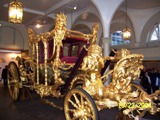 A larger photo of the English royal carriage and
the same design in other countries.
A larger photo of the English royal carriage and
the same design in other countries.
The carriage itself for these huge
cannon were derived from the chassis of a 1600's Italian designed royal carriage
that could handle up to 8 tons. The Spanish modified the design and narrowed
it to carry ore and gold in the new world. Somewhere along the line it was made
to be able to lower the back so it was a dump truck. Ours had a gear drive so
cannons could be elevated very precisely.
The Europeans never thought to use
it for cannons which surprised us all. The Royalty of Europe and almost everyone
of them rode in the solution to the marshes, poor roads and snows of America and Europe
but they never bowed their heads low enough to look at the underside of the carriage they rode in.
All they had to do was to lower their eyes a bit and it would have been obvious what it could be used
for. There were lots of paintings of it (try the Louvre) and I think I had a
painting of the King of England inside one of those very carriages just to look
at for a chuckle now and then.
Even later Napoleon never used the
carriages in Russia where he really could have used them but we sure saw what
it could be used for from the start and did. The Russian aristocracy rode in
them too. We actually managed to kept things a secret back then.
Although you have probably read that
George Washington was a mediocre commander, he was actually the best in the
world.
Prior to the Revolutionary War many English officers including their
top leaders had said he was the best commander in the world. Then they had to fight him. He won our independence and England got really
upset when we made him the first President. Spain's Ambassador to France informed
us that the English Lords actually were afraid that he might turn it all around
and invade England!
Why then do most of the biographers
say that George Washington was a such a poor commander? To that I might add
why did we keep him if he was such a poor leader'? Nobody in America got to be a general
if they were mediocre.
It was a huge plot by us Americans
to create a credibility gap between England's Military and the aristocrat leaders
in order to undermine their entire army and make it no fun at all for them.
George Washington did not like the
game the Europeans made out of war because it cost men's lives. George Washington
made it no fun at all for the English commanders. The commanders knew well of
his skills but the rest of the aristocracy believed the stories about George
Washington being a poor military commander. So when the military leaders during
the Revolutionary War asked England to send more troops the King send back the
message "You have more than enough men. George Washington is a poor commander.'
Of the five largest battles fought
during the Revolutionary war three of them were never recorded or were under reported. One was near
Valley Forge. Every last English soldier was killed and not a single one was
allowed to escape death. No prisoners were taken and no quarter was given in
those battles. The English officers rode away in disgrace. That is how George
Washington wanted it and so the rest of the forefathers tolerated it.
England covered up the records of
the three battles and we blackmailed them to not say anything about those
battles. Most important to the English was to prevent the other European nations
(that they normally had huge wars with) from seeing them as weaker than they
really were.
Even after the war when the English
wanted to retake 'the colonies' the English rulers were under the impression that it could
be done with only 5,000 English troops but the Military leaders said they could
not even hold 'the colonies' with that number. They kept insisting that they
would need 20,000 to hold it and at least 50,000 troops to take 'the colonies'.
So the military leader stopped rattling their swords and it went no where so
the plot worked very nicely thank you.
George was one of the few people
who felt completely comfortable in a battle. Even with artillery directed at
him there was no confusion at all. Once he set up his artillery in such a way
that it forced the English to have to duel with him from a valley with our cannon on a hill. It was just
beyond range for the English artillery. The American cannons could hit theirs directly
but they had to bounce their cannon balls several times to hit the American
artillery. The first shot on both sides were usually made by the best artilleryman
to determine the range and the amount of powder needed for all their cannons.
Then all the artillerymen loaded their cannons the same and in another minute
they all started firing.
Well that first shot came from the
second English cannon from the left. It bounced, rolled and then came to rest
literally at George Washington's feet. He looked down at it and said to himself
'That was a lucky shot, if if he had used a bit more powder that would have
killed me'. That English lead artilleryman had a telescope to see where it had
landed (he could also see who he had almost killed) and must have thought the
same thing since a minute later a dozen English cannon's fired and as Washington
said 'one ball bounced three times and it passed so close to my head that it
rearranged my hair'. He calmly moved over literally only a few inches and sighted
along the three indentations where the ball had bounced to determine that it
was the same cannon that had shot the first ball. Then he walked over to the
best two American artillerymen and said 'Fire at that son of a bitch on the
second cannon from the left'.
They looked at Washington curiously
since for 40 years he had trained his artillerymen including them to ignore individuals
at all costs and aim only at the cannons (or at the largest groupings of men).
George simply added 'He's just too damn good a shot and he is aiming at me.'
At that point George decided that it had become personal so he pushed the stunned
artillerymen out of the way and aimed the cannon himself. It took him four shots
but the English carried their best man off the field.
One or more of these cannons were
in a walled off part of the cellar at Monticello, at least it was when I left
the premises ~189 years ago.
Previous
Page
All rights reserved. © J Pinil,
Inc. 2005
|


